Amrita Sher-Gil: A woman of art in a man’s world
Happy Birthday Amrita! Thank for giving us your art.
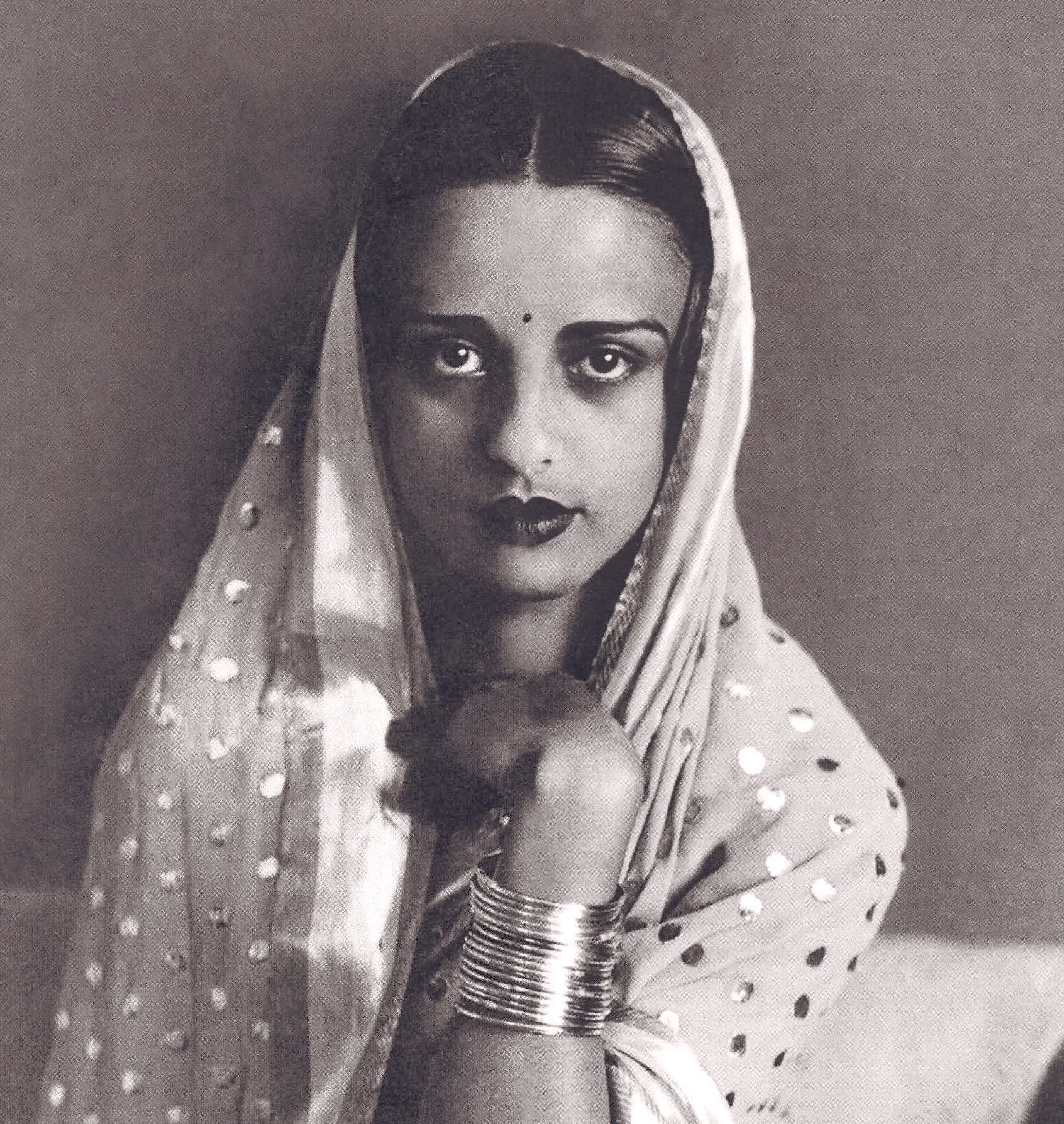
Born on January 30, 1913, Amrita Sher-Gil changed the course of art for female painters in India.
She was born in Hungary to a Jewish-Hungarian mother and Punjabi Sikh father. Her background and early life is reflected in her art, especially the European origins infused with Indian sensibilities. Her artistic style took shape in a predominately male dominant community amongst the changing landscape of art theory. Artists were questioning their allegiance to traditional styles and transitioning to modern art forms. Her training in Paris at the Grande Chaumiere and later the École des Beaux-Arts enabled her to develop this novel style that wasn’t bound by artistic distinctiveness of Western or Eastern boundaries.
Embracing Nudity and Femininity in art
During her training in Paris, Amrita was exposed to works of celebrated artists like Paul Cézanne and Paul Gaugin. Gaugin’s series on indigenous Tahitian Women influenced her during her early days of study in Paris. She created the ‘Self-Portrait as a Tahitian’ but with her own additions like the Asian figure in the background, a shadow of an unknown man, a casually draped white cloth covering her below the navel, deep red puckered lips and her loosely tied hair.
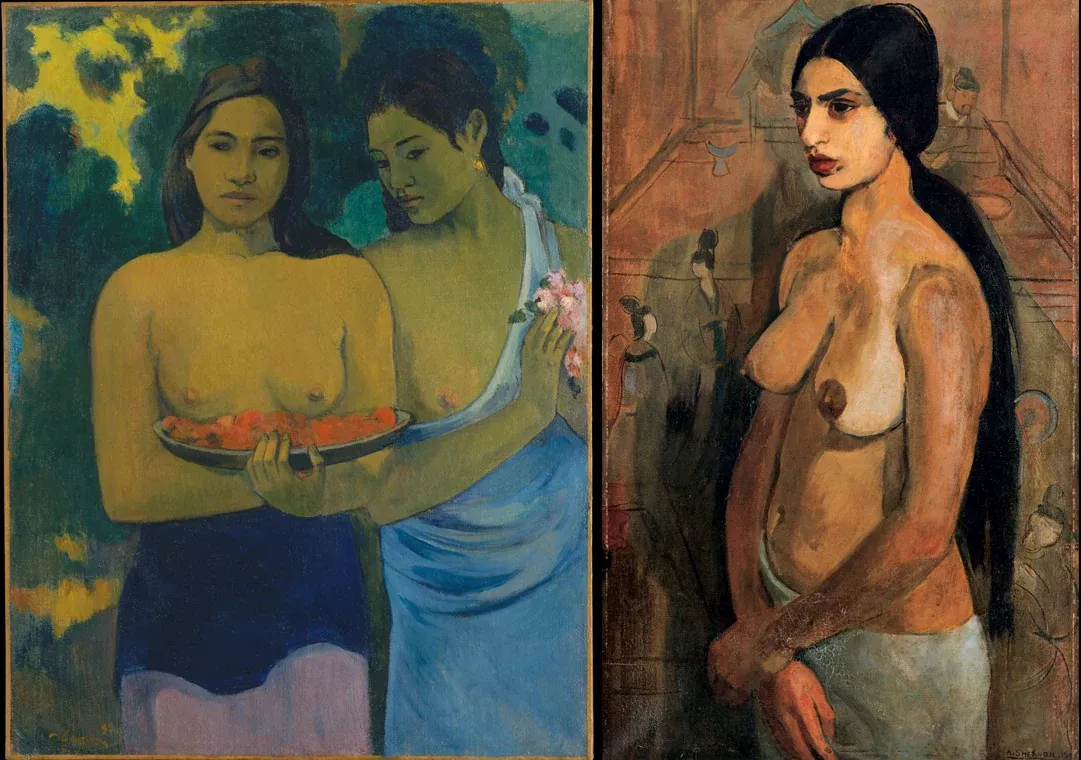
Many of artworks embraced the nudity in pride and grace during her study and ever afterwards. She was unapologetic about it at a time when women were expected to be modest and not considered to have any artistic aptitude (I mean, seriously!). Her style evolved in the same manner as Gauguin, who left Paris for Tahiti, and might have motivated her to move to India.
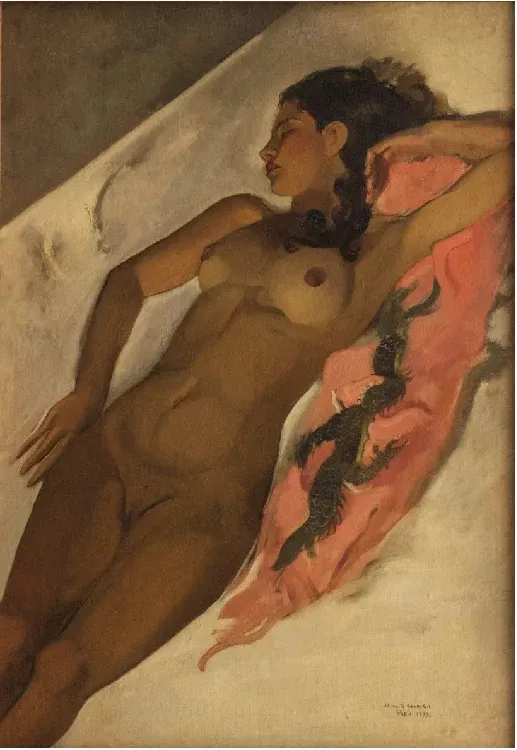
Pioneer to Indian Modernism
After moving to India, the subjects of her paintings changed to the Indian poor, a rare subject for the artists of her time. Even though she may have approached India as someone with a western education, she embraced the country. In her words:
“As soon as I put my foot on Indian soil, my painting underwent a
change not only in subject and spirit but in technical expression,
becoming more Indian. I realised my mission then: to interpret the life
of Indians, and particularly of the poor Indians, pictorially, to paint
the silent images of infinite submission and patience, to depict the
angular brown bodies, strangely beautiful in their ugliness, to
reproduce on canvas the impression their sad eyes created on me.”
Her paintings are described as having a lot of empathy for the new subjects that she chose. In one of the letters she wrote to her friends after her move to India, she is said to have written
“Europe belongs to Picasso, Matisse, Braque…. India belongs only to me.”
Through her painting she blended art styles with real-life subjects from the villages of India, especially women. Capturing them in their true essence on her canvas with her post impressionist style was something unseen in India in early 1900s.
Indian ‘Frida Kahlo’
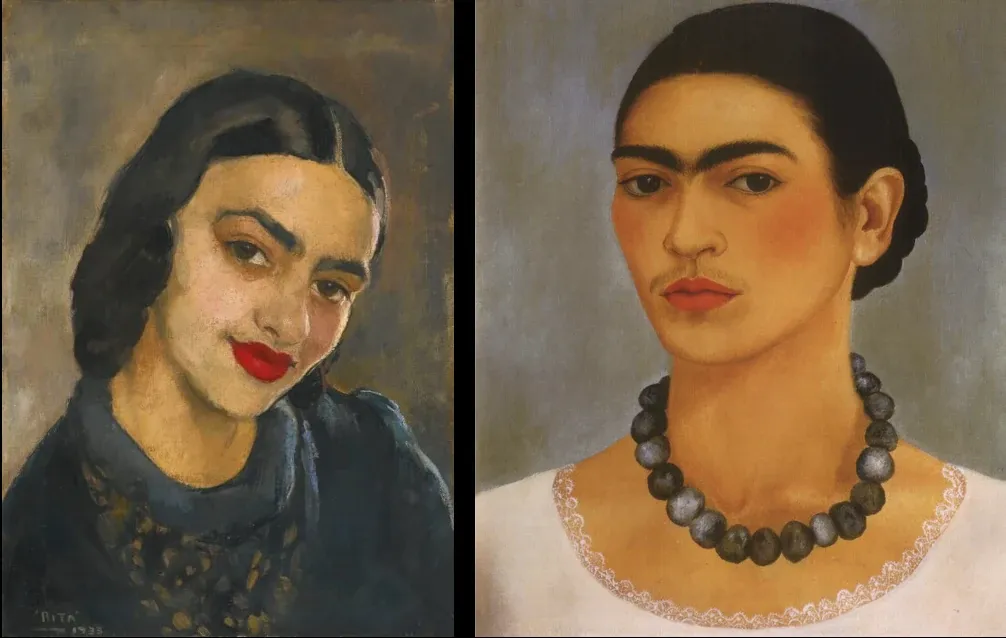
Amrita Sher-Gil is often called the Indian ‘Frida Kahlo’ and in many ways she had a similar life-story. They both lived around the same time and had a interesting similarities in thier artistic expression. They both looked to challenge how the world defined art while embracing their sensuality and femininity. Both of them were also born to photographer fathers which gave them an exposure to the art world at a very early age. They both picked up portraiture very early, likely due to an intuitive understanding and awareness of photography which then went on to become a significant part of their distinctive styles. Their ideologies in life, shaped by struggles and reinforcing their perspectives towards femininity were a few aspects clearly visible in their paintings even at the time they were active.
Amrita passed away at the young age of 28 but left behind her legacy through her over 170 paintings that the Indian art community has come to cherish. Many of her painting are housed at National Gallery of Modern Art (NGMA), New Delhi. NGMA had created a Virtual Tour of her artworks titled “An Unfinished Journey | Amrita Sher-Gil” for her 109th birth anniversary in 2021. Her piece titled ‘The Story Teller’ was auctioned off in September 2023 at around 7.4 million USD. In life, her work never received as much recognition as it does today. Her works are some of the most valued creations by women painters of Indian origin and with good reason. On this 112th birth anniversary of hers, I am happy that I could share a bit of her story. A woman who, with a brush and a few colors, created a world where the rest of us could express ourselves without limits.
To an artist like myself, Amrita is an icon, an inspiration to look up to. She challenged her the social conventions in her paintings while she chiseled a path for female artists in India, even though there were far and few in the 20th century. She is rarely talked about in the art community other than in India, I believe, she deserves more credit for what she represented through her art. Simply, magnificent and thought provoking.
References:
A Painter of Concern: Critical Writings on Amrita Sher-Gil on JSTOR
G.H.R. TILLOTSON, A Painter of Concern: Critical Writings on Amrita Sher-Gil, India International Centre Quarterly…
www.jstor.org
Amrita Sher-Gil on JSTOR
N Iqbal Singh, Amrita Sher-Gil, India International Centre Quarterly, Vol. 2, No. 3 (July 1975), pp. 209-217
www.jstor.org